
Not every headache starts in your head.
You have tracked the triggers, cut things out, tried the medication, and you still lose days to it. When a headache keeps arriving with a stiff neck, tired eyes at the end of a screen day, or a sense that busy rooms are suddenly too much, it is worth checking the systems feeding the head rather than only the head.
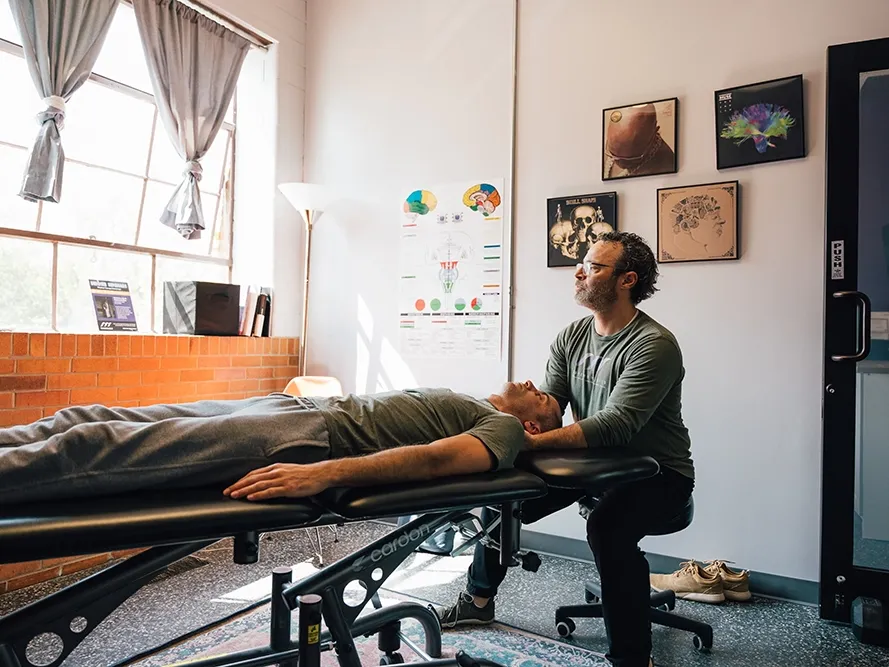
Two mechanisms are treatable here. The upper cervical joints and the muscles at the base of the skull refer pain into the head along well-mapped pathways. So does a visual system working too hard to hold a target steady, which the brain pays for in tension, nausea and fatigue. Adam Wolf has advanced training in vestibular rehab, and the clinic assesses neurovisual dysfunction directly.
Signs your headache has a mechanical source.
These features separate a headache driven by the neck or the visual system from a primary migraine. If several of them sound like your week, an assessment is worth doing before you try another medication.
Same Side Every Time
Pain that stays on one side and does not swap, following the referral pattern of a specific joint in your neck.
A Stiff Neck With It
Rotation is limited on the same side as the headache, and that limitation is often there before the headache arrives.
Worse With Screen Time
It builds through a day at a desk or a long drive, and eases on a weekend away from the screen.
Tender at the Skull Base
Pressure at the base of the skull reproduces your exact headache, which is the single most useful finding in the assessment.
Eye Strain and Glare
Reading, scrolling or fluorescent light wears you out fast, and your eyes feel like they are working harder than they should.
Busy Places Feel Wrong
Grocery aisles, traffic or crowds bring on fog, dizziness or a headache, which points at the vestibular and visual systems.
We treat the neck and the visual system.
The assessment separates the mechanisms. We test motion at the upper cervical joints and whether pressure there reproduces your headache, and we screen how your eyes and inner ear work together to hold a target steady while your head moves. That screening is the part almost nobody has run on you before.
From there the work is specific: joint mobilization for the upper cervical segments, dry needling for suboccipital muscles that will not release, mid-back mobility so the neck stops carrying the load, and vestibular or neurovisual retraining when the screening points that way.
No referral needed in Illinois. In-network with BCBS, PPO and Medicare, and we verify your plan before you start.
Schedule your appointment.
You do not need a referral. Illinois Direct Access lets you see a licensed physical therapist without one, up to 10 visits or 15 business days. We are in-network with BCBS, PPO and Medicare, and we will check your plan before your first visit.
Come in and tell us the whole history, including everything you have already tried and what it did or did not change. We look at how you move, explain what we find in plain language, and build the plan around your life instead of handing you a printed sheet of exercises.
You’re all set.
We’ll reach out within one business day to confirm your appointment. If you need to speak with us sooner, call us directly.