
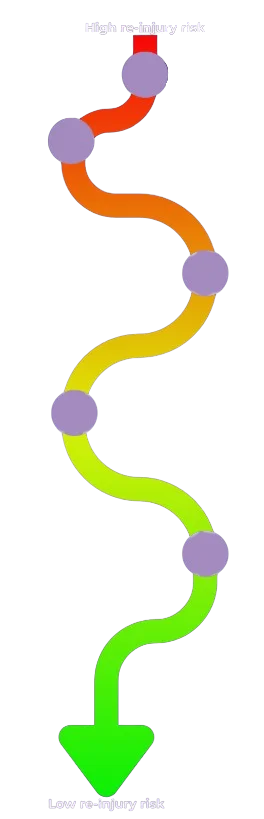
Five stages, and the last two are the point.
The Road to Recovery is the framework this whole practice runs on. It exists because most people who walk in here have already done a round of care somewhere else, one that ended the week the pain got quiet. Then the pain came back, and nobody could tell them why.
Each stage has a job. Each one has a signal that says it is finished. You are told which stage you are in and what has to change before you move to the next one, so care stops feeling like a run of appointments with no visible end.
Every stage has a job and a finish line.
Evaluation
A full look at how you actually move, not just where it hurts. History first, then we test the whole chain, because the painful spot is usually the part paying for a restriction somewhere else. Nothing gets treated until we can explain the driver in language you could repeat to someone else.
Remap
Change the signal. Hands-on work and brain-based movement input give the nervous system a reason to let the guarding go. This comes before strengthening on purpose, because loading a joint the body is still protecting only teaches it to protect harder.
Rebuild
Load it back in, in the pattern you will actually use. Strength that only exists on a treatment table does not transfer to a stroller, a barbell or a flight of stairs. This is the stage where the change stops depending on us and starts belonging to you.
Perform
Capacity beyond the point where the pain stopped. This is the stage most plans skip, and skipping it is the most common reason people end up back where they started. We build margin here, so a heavy week is just a heavy week.
Recovery
The tools that keep it there. Massage, Kinstretch, recovery systems, and a short list of things you do on your own that are actually worth the time. You leave knowing what to do when it flares, which is what independence really looks like.
Schedule Your Appointment
Illinois Direct Access means you can start with a licensed physical therapist without a doctor's referral, up to 10 visits or 15 business days. We are in-network with BCBS, PPO and Medicare, and we will verify your plan before your first visit.
Come in and tell us the whole history, including what you have already tried and where it stopped working. You leave with a read on what is actually driving it and a plan built around how you move.
You’re all set.
We’ll reach out within one business day to confirm your appointment. If you need to speak with us sooner, call us directly.