Vision is a movement system, not just sight.
Two eyes have to point at the same spot, hold it while your head moves, and hand your brain one clear image. That job runs on muscles, timing and reflexes, and it is wired straight into balance and posture. When it takes effort, the effort shows up as headache, fatigue or a low hum of unsteadiness.
Neurovisual dysfunction is what happens when the system still works but works too hard. Testing looks at convergence, tracking, saccades and the eye movements that pair with head motion. Adam Wolf has written about the visual system's role in movement, and it is a standing part of how we assess symptoms nobody has named yet.
We test how your eyes work, not how well you see.
Oculomotor Screen
We watch your eyes do their actual jobs: following a moving target, jumping between two targets, converging on something close, and holding one target steady while your head turns. The patterns show up quickly.
Connecting Eyes to Body
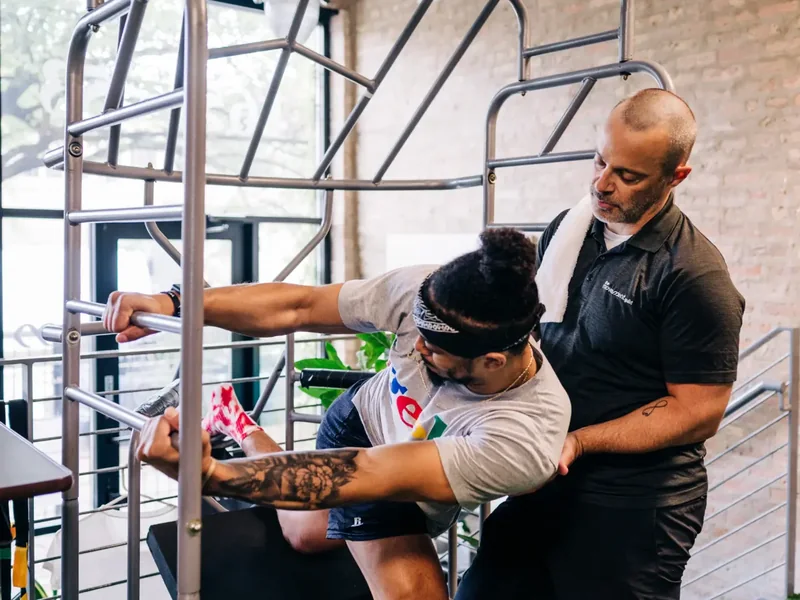
Then we link what your eyes are doing to what the rest of you is doing. Posture, neck position and balance all shift when the visual system strains, and that link is usually where the symptoms are actually generated.
Graded Visual Retraining
You get specific eye movement work, layered with head motion, then with balance, then with whole-body movement. The progression is deliberate, because loading a strained system too fast just reproduces the symptoms.
Schedule your appointment.
You do not need a referral to start. Illinois Direct Access lets you see a licensed physical therapist for up to 10 visits or 15 business days without one, so nothing has to wait on another appointment first.
This does not replace your eye doctor, and we will say so if an eye exam is the right next step. What we test is how the visual system performs during movement. We are in-network with BCBS, PPO and Medicare, and we will verify your plan before you come in.
You’re all set.
We’ll reach out within one business day to confirm your appointment. If you need to speak with us sooner, call us directly.