
Gym-Based Massage Therapy

For lifters and athletes who keep training through soreness, this is massage done right in the gym, aimed at the tissue your current program is actually loading.

Schedule Your Appointment

No referral needed in Illinois · In-network with BCBS, PPO and Medicare.

Prefer to call? (312) 489-8579

Massage where the training actually happens.

Gym-based massage takes the table out of the quiet room and puts it on the training floor. Your therapist can watch you squat, press or run first, treat the tissue that the movement just exposed, then send you back to repeat the movement and see whether anything changed.

That loop is the whole point. In a closed room a therapist works from what you report and what the tissue feels like. On the gym floor they also work from what they can see under load, which is a far more honest source of information.
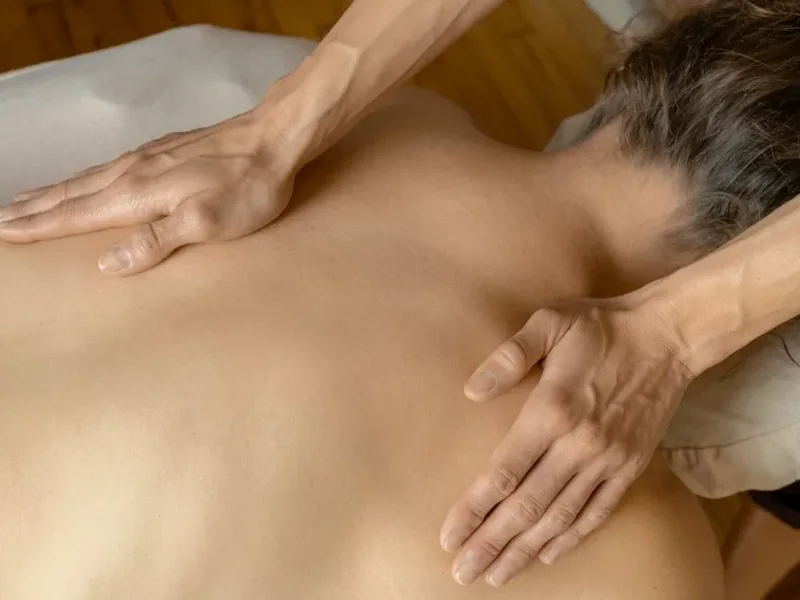
Treatment on the training floor, not a closed room
Movement assessed under load, treated, then retested
Built around the training block you are actually in
Membership tiers run roughly $109 to $129 per service
Massage table set up beside the training floor at The Movement Guild

For people who are still training through it.

This is for the lifter whose bar path changes when a lat locks up, the runner whose calf goes tight at mile four, the athlete in season who cannot stop for six weeks and rest. If you are not training right now, the standard massage room is the better fit for you.

Lifters in a Training Block
In-Season Athletes
Runners Mid-Training Cycle
Sticking Points in a Lift
Recurring Training Soreness
Restrictions That Survive the Warm-Up
Overhead Mobility Limits
Hip and Ankle Range for Squatting
Grip and Forearm Load
Hamstring and Calf Tightness
Return to Sport After Rehab
Competition Prep Weeks

Watch it, treat it, then load it again.

Show the Movement

You start by demonstrating the lift or the stride that is not going well. What feels stiff lying on a table is not always what limits you under a loaded barbell, and that difference is the whole reason to be out here.

Treat the Suspect Tissue

Hands-on work goes to the tissue the movement implicated, not across a whole body that mostly feels fine. Sessions can be shorter and more concentrated because the target is already specific.

Retest Under Load

You go straight back to the same movement. If it changed, the session worked. If it did not, that is useful too, and the finding goes to a clinician, because tissue was not the limiter.

Bodywork that answers to the barbell.

Feeling loose is easy to produce and hard to keep. Retesting the movement immediately after the work tells you whether the tissue was ever the problem, and that answer is worth more to a training program than an hour of feeling relaxed.

An Immediate Retest

You find out inside the session whether the treatment changed the movement, instead of guessing at it on your next training day.

Session Time Where It Counts

Work is concentrated on the tissue limiting your current lifts, rather than spread evenly over a body that is mostly doing fine.

Training Stays On

Treatment fits around your program rather than replacing it, so you keep training while the restriction is addressed instead of resting through it.

One Team, One Problem

Your massage therapist, your coach and your physical therapist are in the same building, looking at the same movement.

Book a session on the training floor.

Tell us what you are training for and what is not moving well right now. Talking to a specialist is where we work out whether gym-based massage, the clinic room, or something clinical entirely is the right call for you.

Membership tiers cover massage, personal training, yoga and Kinstretch at roughly $109 to $129 per service depending on your commitment level. Ask on the form and we will lay the options out without a sales pitch.

Prefer to call? (312) 489-8579