
Concussion Management in Chicago

If headaches, fog or dizziness are still hanging on weeks after the hit, we test the balance, vision and neck systems and rebuild your tolerance one step at a time.

Schedule Your Appointment

No referral needed in Illinois · In-network with BCBS, PPO and Medicare.

Prefer to call? (312) 489-8579

A concussion is a brain injury, not a bruise.

A concussion changes how the brain handles incoming signals, and the systems it leans on hardest are the ones that keep you oriented: balance, vision and the neck. Most people recover. When symptoms hang on well past the hit, it is usually because one of those three has not come back online with the others.

Rest stops being the whole answer at that point. Graded return to activity means testing each system, treating whatever tests poorly, and adding load in controlled steps so the brain relearns tolerance instead of learning to avoid.
Vestibular, visual and neck systems all get tested
Graded return to activity, not open-ended rest
The neck is injured by the same force
Your symptoms set the pace of every progression
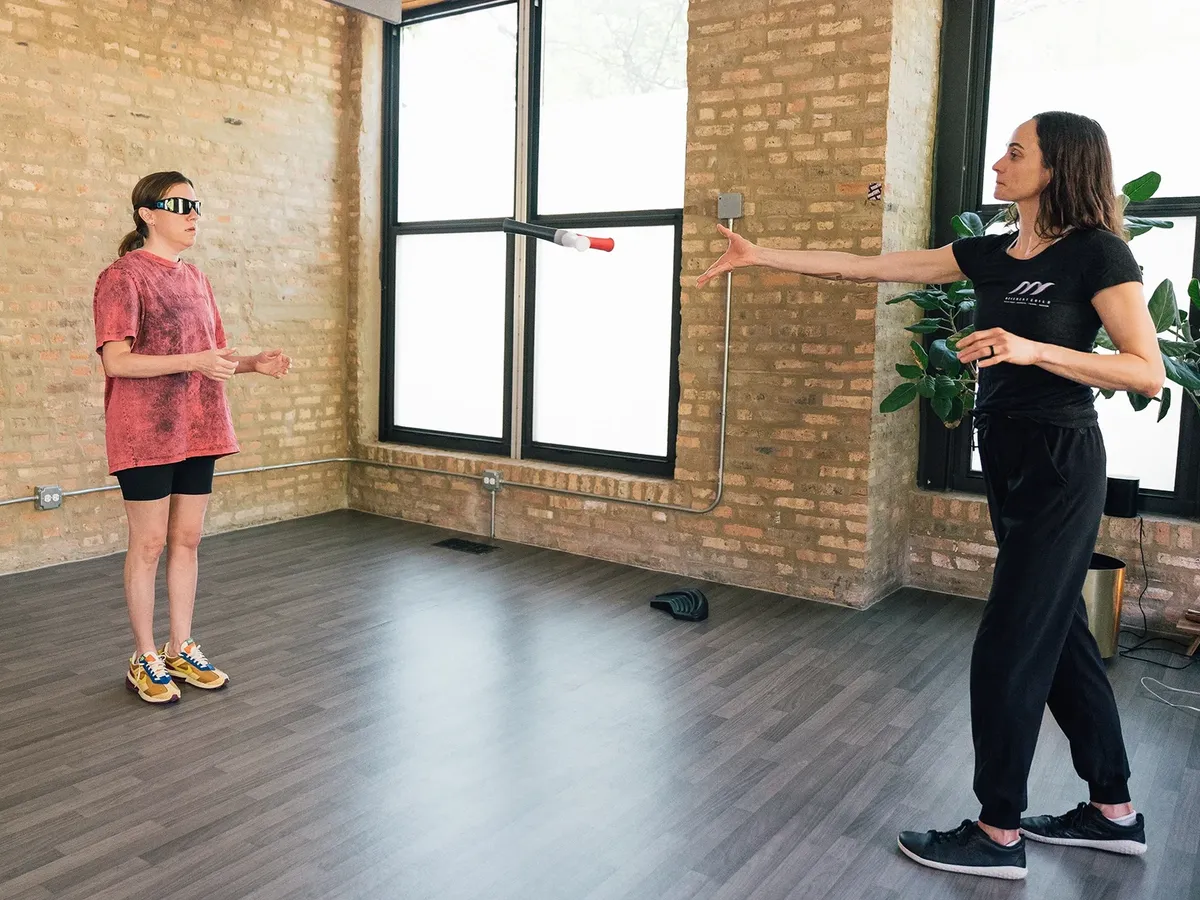
A clinician running a visual reaction drill with a patient at The Movement Guild in Chicago

For symptoms that outlasted the rest period.

You were told to sit in a dark room. It helped, and then it stopped helping. Headaches, fog, dizziness and the sense that your own eyes are wearing you out are not proof you rested wrong. They are a sign that a specific system needs testing rather than more time.

Lingering Post-Concussion Headaches
Dizziness With Head Movement
Brain Fog and Slow Processing
Neck Pain After the Impact
Screen and Light Intolerance
Balance Loss and Unsteadiness
Symptoms That Spike With Exercise
Nausea With Motion
Trouble Reading or Focusing
Noise Sensitivity
Disrupted Sleep Since the Injury
Return to Sport Readiness

Find the system that has not caught up.

Multi-System Testing

Vestibular, oculomotor, cervical and exertion testing, run together rather than one at a time. Post-concussion symptoms overlap heavily, so the job is working out which system is generating yours.

Treat the Driver

Whatever tested poorly gets treated directly: gaze stability and habituation for the vestibular side, graded eye movement work for the visual side, manual therapy and motor control for the neck.

Graded Return to Load

Then activity comes back in steps you can tolerate, with your symptoms as the guide. Cardio, then complexity, then contact or competition where that applies. Nothing gets skipped because you had a good day.

A route back that does not rely on waiting.

Testing turns a vague recovery into something with parts. Once you know which system is lagging, there is something specific to work on and a set of progressions to measure it against.

Symptoms With a Source

Dizziness, headache and fog stop being one undifferentiated problem once testing shows which system each of them is coming from.

Tolerance for Real Life

Screens, work, driving and errands come back in controlled steps instead of as a test you either pass or fail.

A Neck That Is Not Overlooked

The force that shook the brain also loaded the neck. Treating it removes a common and often missed source of lingering headache.

A Confident Return to Sport

Graded exertion and complexity rebuild readiness, so going back is a decision made on testing rather than on the calendar.

Schedule your appointment.

You do not need a referral to start. Illinois Direct Access lets you see a licensed physical therapist for up to 10 visits or 15 business days without one, so the testing does not have to wait on another appointment.

If you are in the acute stage or your symptoms are worsening, get medical care first and come to us for the return-to-activity work. We are in-network with BCBS, PPO and Medicare, and we will verify your plan before you come in.

Prefer to call? (312) 489-8579